
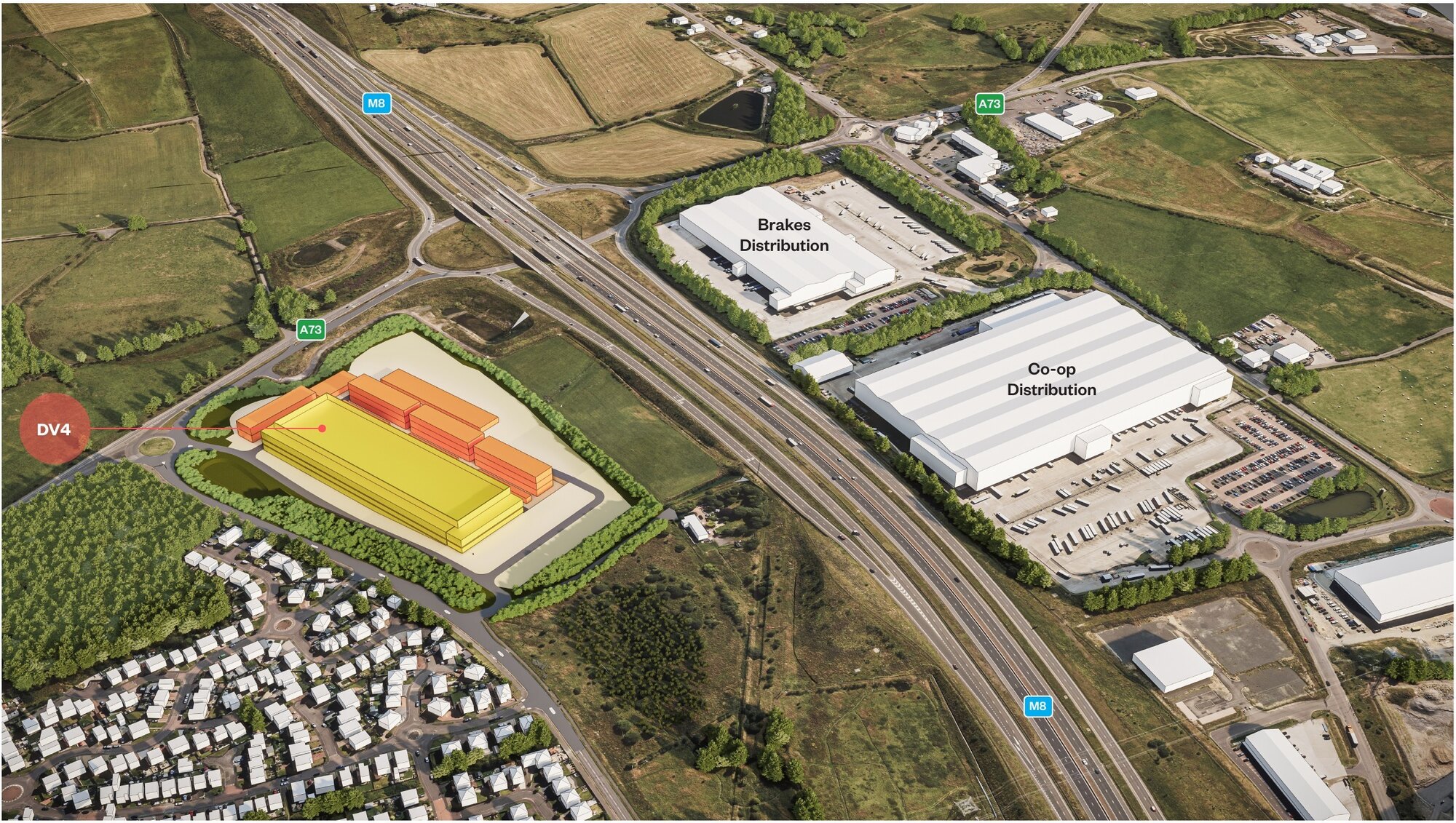
DataVita, Scotland’s homegrown data centre operator and cloud provider, has submitted a planning application to North Lanarkshire Council for DV4, a new data centre at Chapelhall. The site forms part of the Lanarkshire AI Growth Zone, designated by the UK Government in January 2026 as the first in Scotland.
- Proposals include £849.6 million of construction investment over two years
- Plans would deliver 2,650 construction job years and 120 permanent skilled roles on site, with apprenticeships
- At least 40% of capital contracts expected to be delivered by local suppliers
- The site forms part of the Lanarkshire AI Growth Zone, the first designated in Scotland by the UK Government
The next stage of the Chapelhall campus
DV4 is the next stage of a campus DataVita has operated for more than ten years. The company built, owns and runs DV1 at Chapelhall, Scotland’s largest purpose-built Tier III certified data centre. It is also constructing DV3 next door and operates its second facility in Glasgow.
DataVita is also the largest supplier of cloud services to the Scottish public sector through the Scottish Government’s Cloud and Hosting Services framework, with services used every day across Scotland running on its infrastructure. The company is headquartered in Lanarkshire and employs its team in Scotland, as well as building and operating its own facilities.
The submission for planning permission in principle is supported by a full suite of technical assessments, covering energy and decarbonisation, noise, air quality, transport, flood risk and drainage, ecology and landscape, heritage, ground conditions, economic impact and construction environmental management, so that the council and the public can see more detail of the proposals now, rather than later.
Shaped by public consultation
DataVita held four public consultation events, more than the two required, published all exhibition material online throughout, and issued a public FAQ, updated after each event. Feedback has shaped the design of the development. The maximum building height has been reduced from 30 metres to 26 metres, operational plant has been placed to the south of the building away from homes, and around 1,000 metres of new native hedgerow will be planted, at least double the length being removed.
A feasibility study is under way for a community garden and greenhouse, warmed by surplus heat from the data centre, an idea raised by residents at the consultation events which would be funded through a community investment fund.
Danny Quinn, Managing Director of DataVita, said:
“We have seen a lot of data centre speculation in Scotland recently, and the vast majority of it will never be built. DataVita has been operating in Scotland for more than ten years, and we already underpin a lot of the critical services used day in, day out across Scotland. We built DV1 at Chapelhall, we are building DV3, and we run them ourselves with a Scottish team. DV4 is the next stage of that campus.
“Not all data centres are the same, and we are keen to change the public perception. Scotland has an opportunity not only to become a data centre location but an exporter of intelligence via low-carbon data centres. We don’t think of exporting barley when we talk about the success of our whisky industry, and data centres should be no different.
“The application is now with the council and open for comment, and I would encourage people to look at the detail.”
Designed to meet Scotland’s green data centre criteria
DV4 is designed to meet the four criteria the Scottish Government recommends for green data centres. It will run on 100% renewable electricity backed by certificated Scottish generation. Its efficiency target is a power usage effectiveness below 1.25, ahead of the recognised European benchmark for cool climates.
Cooling for the facility is closed loop and sealed, with no evaporative cooling, and a water usage target of 0.05 litres per kilowatt hour or lower. That is at most an egg cup of water for a washing machine cycle’s worth of electricity, around a thousand times less water than the wash itself uses. In practice the sealed system tops up less water in a year than one Scottish resident uses at home. Heat recovery is built in from day one, and DataVita is in discussions with the new Monklands Replacement Hospital and the neighbouring BioCity campus on the reuse of surplus heat.
Air quality and standby generation
DataVita has also gone well beyond what an application at this stage requires on air quality. The assessment models deliberately extreme scenarios, including every standby generator across DV1, DV3 and DV4 running at the same time and a continuous 72-hour emergency, conditions that have never arisen. In more than ten years of operation, the Chapelhall campus has not experienced a single grid power cut, and DV1’s standby generators have been needed for a total of one hour of unplanned running in that decade, outside the routine tests every operator carries out. The generators at DV4 will run on renewable HVO fuel with advanced emissions controls, and the installation will operate under a SEPA permit, which applies the best available techniques standard.
Investment, jobs and community fund
The development represents £849.6 million of construction investment over two years, supporting 2,650 construction job years and 120 permanent skilled roles on site, with apprenticeships, and at least 40% of capital contracts expected to be delivered by local suppliers. DV4 is expected to generate more than £30 million in business rates for North Lanarkshire Council over 25 years. Alongside this, DataVita will invest £75 million over 15 years in a DV4 Community Investment Fund, governed by an independent board, to invest in local community-generated and led projects.
Scotland’s first AI Growth Zone
The Lanarkshire AI Growth Zone is a pillar of the UK Government’s Modern Industrial Strategy and is expected to bring £8.2 billion of private investment, more than 3,400 jobs and a community fund of up to £543 million to the region. Scotland’s AI Strategy 2026-2031, published by the Scottish Government in March 2026, includes a commitment to promote Scotland as a centre for green data centres and to maximise the economic potential of the Lanarkshire AI Growth Zone. Data centres of this kind are recognised as a national development under National Planning Framework 4.
The application will be available on North Lanarkshire Council’s planning portal once validated, and members of the public can make representations to the council as part of the statutory process.
Media enquiries
- Stewart Argo, Lighthouse PR - stewart@lighthousepr.co.uk, +44 7593 548488
- Peter McFarlane, Syncopated Communications - peter@syncopatedcomms.co.uk, +44 7412 739 093
Notes to editors
- DataVita is a Scottish data centre operator and cloud services provider headquartered in Lanarkshire. It operates DV1 at Chapelhall and a second facility in Glasgow, with DV3 under construction at Chapelhall, and is the largest supplier of cloud services to the Scottish public sector through the Scottish Government’s Cloud and Hosting Services framework (SP-22-023). Its operating sites run on 100% renewable, REGO-backed electricity and were independently assessed in 2025 against the EU Code of Conduct for Data Centre Energy Efficiency.
- The application is a Planning Permission in Principle submission to North Lanarkshire Council for a data centre with associated infrastructure at Lancaster Avenue, Chapelhall, on a site allocated as a Specialised Business Site in the North Lanarkshire Local Development Plan.
- The air quality assessment submitted with the application is a cumulative assessment covering the DV1, DV3 and DV4 sites together, using five years of meteorological data and worst-case operating assumptions that have never arisen in practice.
- The Lanarkshire AI Growth Zone was announced by the UK Government in January 2026 as Scotland’s first AI Growth Zone.
- The four green data centre criteria referenced by the Scottish Government’s Chief Planner are renewable power, energy efficient technologies, minimised water consumption and reuse of excess heat.